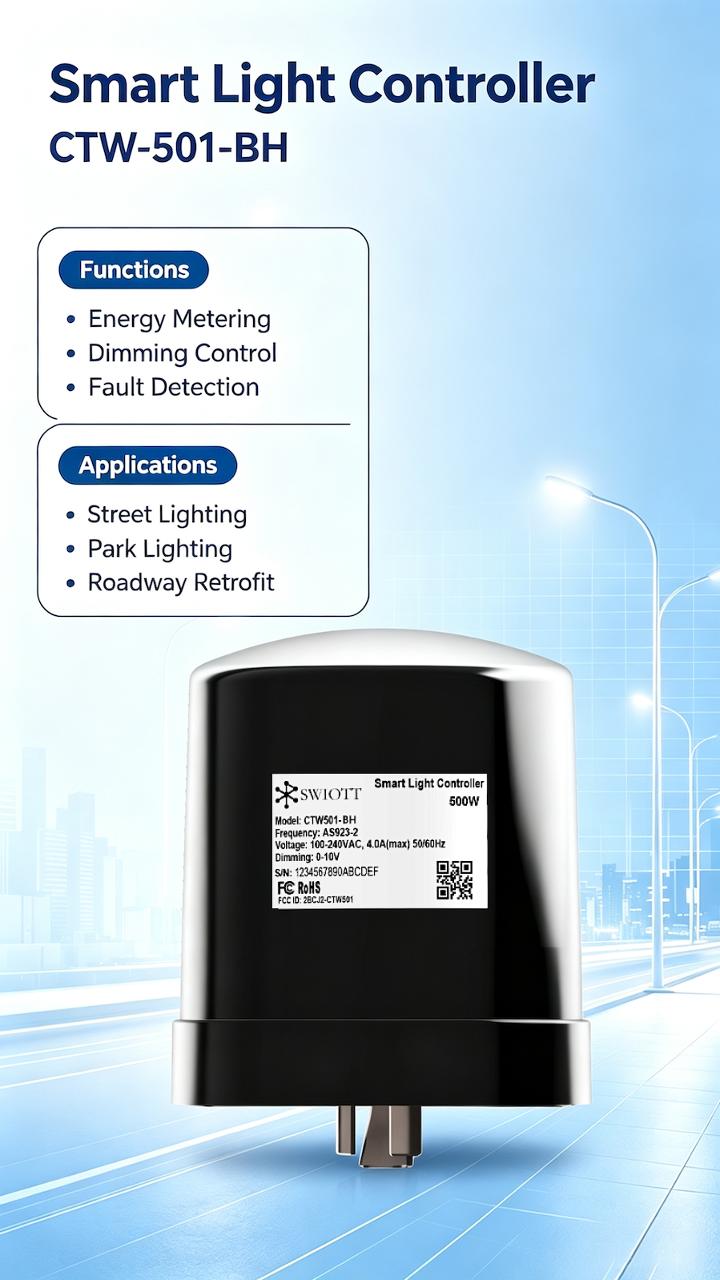
SWOTT CTW501 LoRaWAN street light controller delivers plug-and-play upgrades via standard NEMA socket. It supports long-range communication, dimming, energy metering and offline schedules for urban, highway and industrial lighting projects.
Learn more:https://swiott.com/products/ctw501-lorawan-nema-smart-street-light-controller
SWOTT CTW501 NEMA LoRaWAN smart street light controller brings a simplified path for the digital transformation of urban public lighting. The universal NEMA interface enables direct installation on existing street light fixtures, removing the need for large-scale site reconstruction and cutting construction cycles and labour investment for lighting upgrade projects.
Built upon the internationally recognised LoRaWAN protocol, the controller works on multiple licence-free frequency bands and achieves extended transmission range and strong signal penetration. When matched with SWOTT GTW721 outdoor LoRaWAN gateway and cloud-based lighting management platform, it builds reliable low-power lighting networks covering urban road networks, suburban thoroughfares, industrial zones and scenic areas. An optional NB-IoT variant can cater to different networking requirements.
The controller supports 0-10V, PWM and DALI dimming signals to support individual lamp control, regional group control and network-wide synchronous dimming, with continuous brightness adjustment available between 10% and 100%. Operators can combine timing plans, ambient light detection and weather responsive logic to form adaptive lighting strategies and reduce unnecessary power consumption.
Integrated high precision metering components continuously track voltage, current, active power and accumulated energy consumption, with measurement accuracy maintained below 1%. The unit can automatically identify equipment abnormalities including lamp damage, overvoltage, short circuit and excessive temperature and send out active warning notifications. Local data storage keeps complete operational records during temporary cloud connection interruption and supports later maintenance and energy consumption analysis.
The controller adopts IP65 waterproof industrial hardware and operates stably within the temperature range from minus 40 degrees Celsius to plus 75 degrees Celsius to withstand complex outdoor weather conditions. The built-in real-time clock allows the system to execute preset lighting schedules independently, so street lights maintain normal switching and dimming logic even when the cloud connection fails and improve overall system stability.
The supporting cloud lighting management platform enables multi-terminal access via computers, tablets and mobile devices. Project managers can check equipment distribution and operating status on electronic maps, remotely adjust the working state of single lamps or lamp groups and configure automatic control logic triggered by timing tasks and sensor data. The system collects long-term operational data to generate energy-saving statistics and equipment operation trend information and supports hierarchical user authority configuration and systematic security protection.
We supply a complete set of hardware and software solutions consisting of CTW501 terminal controllers, GTW721 outdoor gateways and cloud management platforms to deliver full set service for smart city road lighting, rural road lighting, industrial park lighting and highway lighting projects. Rapid on-site retrofitting makes it unnecessary to replace original lamp housings, and long-distance LoRa communication helps reduce the total quantity of gateways deployed on site.
Accurate power data provides visible energy saving effects, proactive fault alerts lower the frequency of routine manual inspection, offline independent operation reduces risks caused by network failure, and the open cloud platform interface allows seamless connection with third-party smart city systems. Stable mass production capacity and professional technical after-sales service can support medium and large-scale lighting transformation projects. Send over your project information and we can develop targeted intelligent lighting solutions to support the digital upgrading of urban public lighting systems.

