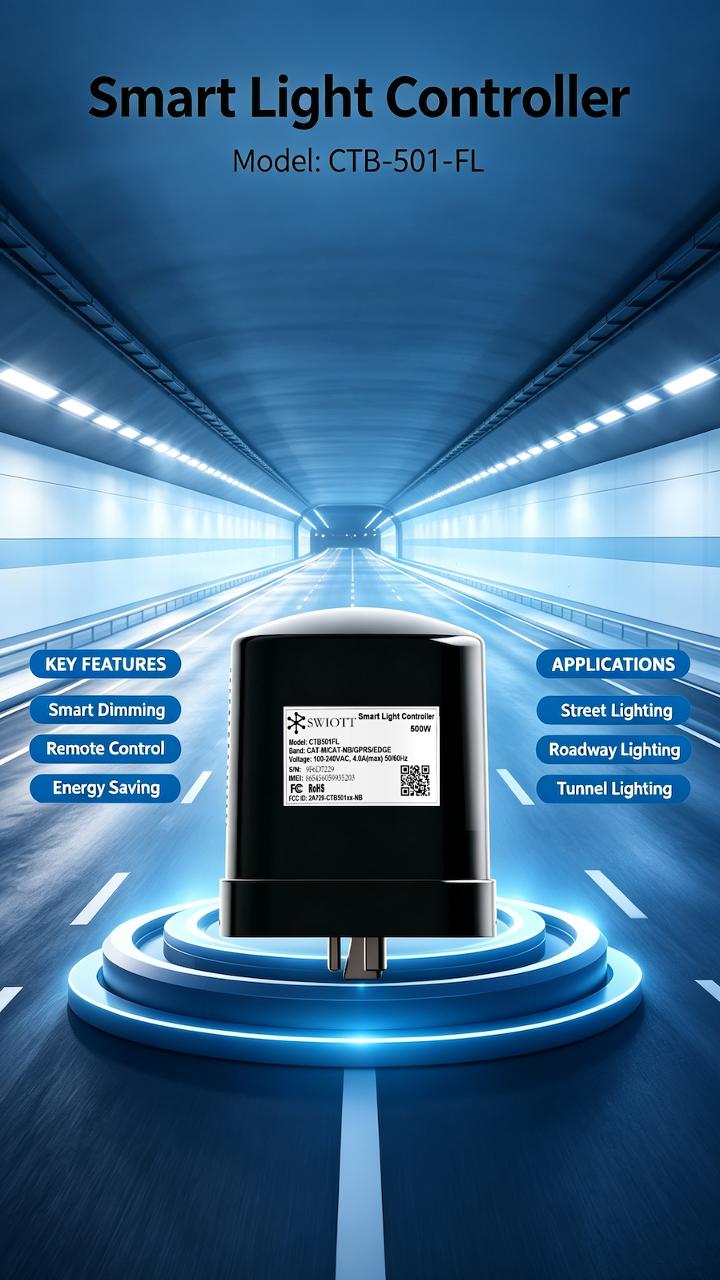
Traditional street lighting is energy inefficient and lacks remote control. The plug-and-play SWIOTT NEMA CTB cellular IoT controller turns ordinary streetlights into an intelligent network, featuring precise dimming, energy monitoring, asset tracking and global cloud management for smart cities.
 Learn more:https://swiott.com/products/ctb501-nb-iot-smart-street-light-controller
Conventional public street lighting suffers high power consumption. Operators mainly rely on manual field inspections without real-time remote monitoring, and cannot obtain actionable operational data. This brings persistent financial pressure to municipal authorities, industrial park operators and port management departments.
SWIOTT NEMA CTB smart street light controller offers a complete end-to-end cellular IoT lighting solution. It enables users to connect scattered ordinary street lights and build an integrated intelligent urban lighting ecosystem. Designed to comply with global NEMA ANSI C136.41 standards and fitted with standard sockets, this plug-and-play controller can be installed on existing street lamp hardware without large-scale reconstruction. Equipped with industrial IP66 dustproof and waterproof housing, the unit runs reliably under harsh outdoor conditions all year round. It supports an input voltage range of 90–277VAC and handles a maximum load of 1000W, making it compatible with most LED street lights used globally.
Powered by Qualcomm cellular communication chips, the controller supports dual-mode 4G and 2G cellular communication including LTE-NB, CAT-M and GSM, and supports frequency bands for regions across the globe. Encrypted high-speed MQTT communication guarantees stable and continuous data transmission across continents, supporting reliable rollout of smart city projects internationally.
The hardware supports accurate dimming via 0–10V and PWM interfaces. Combined with astronomical clock functions, built-in light sensors and configurable timing plans, adaptive lighting control can be achieved. Lights can be dimmed during low-traffic midnight hours, brightened during peak periods, and switched automatically with sunrise and sunset cycles, cutting overall lighting power consumption.
An integrated metering chip achieves measurement accuracy up to 1.5%. Every street light node independently collects real-time voltage, current, active power, power factor and accumulated power consumption. Detailed energy analysis reports can be generated to measure energy-saving outcomes and optimize long-term operation strategies.
A built-in gyroscope quickly identifies lamp tilt, collision impact, vibration and seismic activity. Integrated GPS, GNSS and Beidou positioning automatically records geographic coordinates during installation to support visual asset management on cloud platforms. Timely fault notifications help eliminate blind areas in maintenance arrangements.
The web-based management system supports access via computers, tablets and mobile terminals. Operators are able to control individual lamps, configure grouped lighting schedules, view real-time operating status, perform remote switching and dimming, receive automatic fault alerts and carry out data analysis. Built on an open API framework, the platform achieves seamless connection with mainstream IoT cloud services such as AWS, Microsoft Azure IoT, Google Cloud IoT and IBM Watson IoT, enabling deep integration into large-scale smart city systems.
The device is suitable for urban trunk roads, municipal road networks, industrial zones, port logistics hubs, tunnels, commercial plazas, urban parks and public tourist areas. The expandable lighting control system fits newly constructed intelligent lighting projects as well as renovation programs for legacy lighting systems.
Adaptive dimming and intelligent scheduling effectively reduce electricity expenditure, while remote monitoring and instant fault alerts lower the frequency of patrol drives and on-site manual maintenance. Consistent adjustable lighting plus rapid equipment failure notifications improve urban safety management. Users can deploy distributed IoT networks capable of expansion to accommodate additional smart city services, supporting sustained urban digital transformation.
SWIOTT provides fully certified hardware complying with CE, RoHS and FCC standards alongside comprehensive integrated software solutions. Upgrade public lighting infrastructure with the SWIOTT NEMA NB-IoT smart street lighting control system, and jointly build sustainable, low-carbon interconnected cities for the future. Contact our team to receive customized smart street lighting solutions.

